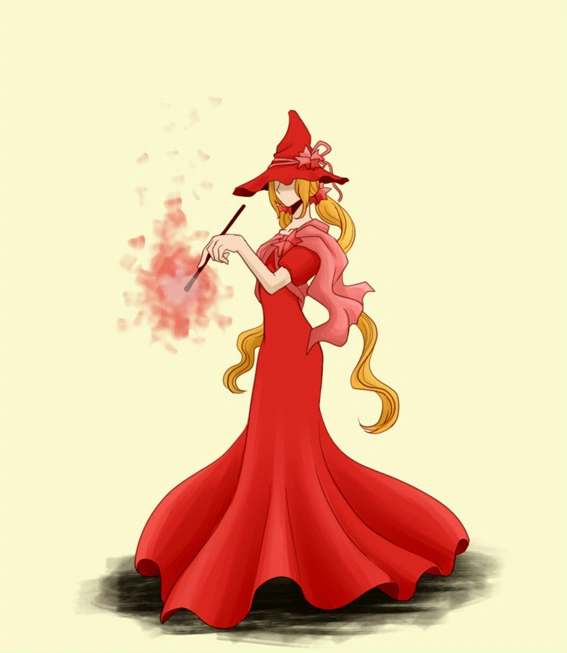

Borrowing the power of the gods
Unlike gods and suras, who are able to use transcendental skills using their own power, humans (excluding halfs) are unable to use transcendentals. However, they can borrow the power of a god or a sura (nastika). This power which they borrow is called magic, and humans who can use magic are called magicians. Among suras, only the power of nastikas can be borrowed. This strengthens the claims of many scholars that nastikas are evil gods rather than suras.[1][2]
Spells are derived from transcendentals used by the source entity.[3] For example, hoti kubera is derived from the earth-type transcendental skill Gigantic Force.
History of magic
In the past, magicians could use two types of magic:[4]
- Divine magic, borrowing the power of a god.
- Fiendish magic, borrowing the power of a nastika.
Magicians were able to use both kinds of magic, depending on their divine and fiendish affinities, and borrow the power of many different gods and nastikas. However, a little over a thousand years ago, around the year D0,[5] humans severed their ties with the suras and chose to borrow power from only the gods. As a result, fiendish magic disappeared and only divine magic remained,[1] thus reducing the number of spells a magician could cast. However, magicians were still able to borrow power from many gods, even though there was a limit of 12 birth attributes.[6]
The primeval god Kali disappeared roughly 300 years before the beginning of the story. Since she was the only god with the Chaos attribute, Chaos magic disappeared with her.[7][8] However, for unknown reasons, Teo Rakan is able to use Chaos silent magic (see below), which should have disappeared as well.[8]
As a result of the Cataclysm in the year N0 (15 years before the beginning of the story), there were now only 11 gods (apparently the strongest for each attribute) from whom to borrow power, and the number of spells a magician could cast was also drastically reduced. Therefore, magicians had to use their smaller pool of spells in a more efficient manner. In other words, less silent magic and word magic (hoti magic, bhavati magic, and summoning magic) could be used for each attribute. Magicians who felt limited by using only one kind of magic created fusion magic by combining two kinds of magic into one.[1]
Divine magic
Currently, divine magic can be divided into several types:
- Word magic: these require uttering a magic word to cast the spell, and include:
- hoti magic: these can be used by anyone, regardless of their birth attributes. Daily usage and power increases if you have more of the right attributes.[9]
- bhavati magic: these can only be used by those with a corresponding birth attribute. Daily usage and power increases if you have more of the corresponding attributes.[9]
- Idha Etu magic: this spell is used to summon a god. This requires no formulations, but requires part of the summoner's lifespan, and can normally only be used by summoners with a triple attribute for the god they want to summon.[10]
- fusion magic: this is not a separate magic category in the proper sense. Instead it fuses two or more hoti or bhavati spells to create a spell with a new effect.
- Silent magic: these do not require a spell or vigor.[11] However, using silent magic in combination with word magic may increase vigor usage. This is the case, for example, when using silent magic to control the path of hot indra.[12]
Both hoti and bhavati mean existence in the language of gods, and both require math formulations to be cast correctly. idha etu means in this place, alight in the language of gods.[10]
Fiendish magic
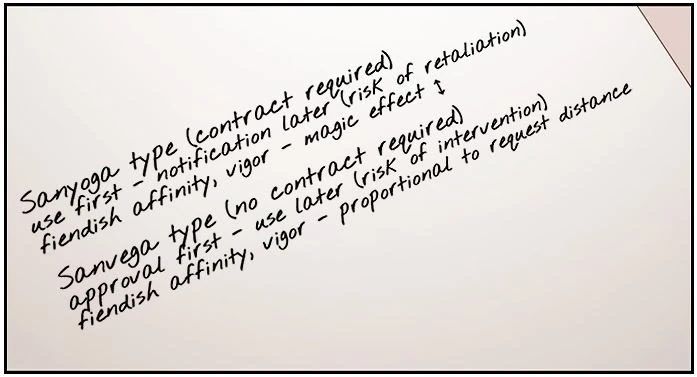

Enan's explanation on the fiendish magic types[13].
This type of magic, borrowing the power of a nastika, could be used by humans until around the year D0.[5] It was dangerous to use, since miscasting could result in the destruction of the magician and his allies as well as his enemies. This is rooted in the fact that the Nastikas can control the skill borrowed to the humans. If they are annoyed, or just fickle, they can make the fiendish magician who casts their spell go berserk. It was implied that Nastikas are blamed for magic murders that happen through their spells[14].
Fiendish magic had its own equivalent of divine affinity, named fiendish affinity. Especially Halfs were known to specialize in fiendish magic, since they have high fiendish affinity[15].
Two kinds of fiendish magic have been revealed[16]:
- Sanyoga magic, requires the spell caster to have a contract with a Nastika, and has little to no side effects on the caster, depending on the Nastika from which the power is borrowed. A person may have contracts with more than one Nastika. The caster's request is sent after the use of the spell, and may incur the Nastika's wrath ("retaliation") if not used in a way the sura finds agreeable.
- Sanvega magic, can be cast without contract, but the caster must obtain permission first before they can use the spell, risking interference with the casting. The caster has to bridge the distance between themself and the Nastika to place a request, and the success (at great distances) depends on their fiendish affinity. Vigor is consumed proportional to the distance. Since the Nastikas are forced to hear the Sanvega requests, they might get annoyed and punish the humans for calling out to them.
The names seem to be inspired from the Sanskrit words संयोग (samyoga) which means connection or association, and संवेग (samvega) which means haste.
Gallery


References
- ↑ 1.0 1.1 1.2 Currygom's blog, Magic: Magic and magicians
- ↑ Currygom's blog, Season 1 Episode 14: The Sorrow of Loss (3)
- ↑ Kubera, Season 1 Episode 34: The Golden Knight (8)
- ↑ the finite, Chapter 2
- ↑ 5.0 5.1 Kubera, Season 2 Episode 27: Reflection (1)
- ↑ Currygom's blog, Magic: Six factors that determine magical talent
- ↑ Kubera, Season 2 Episode 12: Blood (7)
- ↑ 8.0 8.1 Kubera, Season 2 Episode 57: Grudge (7)
- ↑ 9.0 9.1 Kubera, Season 1 Episode 24: AAA Magician (4)
- ↑ 10.0 10.1 Kubera, Season 1 Episode 65: The Night it Rained Fire (2)
- ↑ Kubera, Season 1 Episode 64: The Night it Rained Fire (1)
- ↑ Kubera, Season 2 Episode 13: The Weapon of a God (1)
- ↑ Episode 3-221
- ↑ Episode 3-229
- ↑ Episode 3-220
- ↑ Episode 3-221