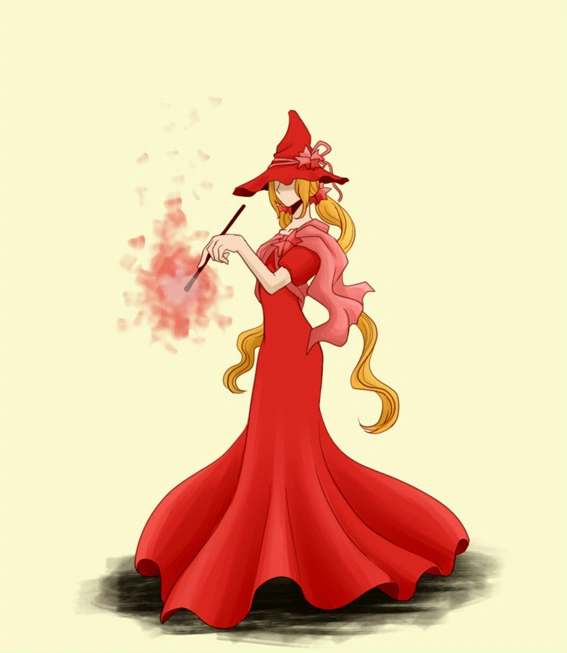

Borrowing the power of the gods
Unlike gods and suras, who are able to use transcendental skills using their own power, humans (excluding halfs) are unable to use transcendentals. However, they can borrow the power of a god or a sura (nastika). This power which they borrow is called magic, and humans who can use magic are called magicians. Among suras, only the power of nastikas can be borrowed. This strengthens the claims of many scholars that nastikas are evil gods rather than suras.[1][2]
Spells are derived from transcendentals used by the source entity.[3] For example, hoti kubera is derived from the earth-type transcendental skill Gigantic Force.
History of magic
In the past, magicians could use two types of magic:[4]
- Divine magic, borrowing the power of a god.
- Fiendish magic, borrowing the power of a nastika.
Magicians were able to use both kinds of magic, depending on their divine and fiendish affinities, and borrow the power of many different gods and nastikas. However, a little over a thousand years ago, around the year D0,[5] humans severed their ties with the suras and chose to borrow power from only the gods. As a result, fiendish magic disappeared and only divine magic remained,[1] thus reducing the number of spells a magician could cast. However, magicians were still able to borrow power from many gods, even though there was a limit of 12 birth attributes.[6]
The primeval god Kali disappeared roughly 300 years before the beginning of the story. Since she was the only god with the Chaos attribute, Chaos magic disappeared with her.[7][8] However, for unknown reasons, Teo Rakan is able to use Chaos silent magic (see below), which should have disappeared as well.[8]
As a result of the Cataclysm in the year N0 (15 years before the beginning of the story), there were now only 11 gods (apparently the strongest for each attribute) from whom to borrow power, and the number of spells a magician could cast was also drastically reduced. Therefore, magicians had to use their smaller pool of spells in a more efficient manner. In other words, less silent magic and word magic (hoti magic, bhavati magic, and summoning magic) could be used for each attribute. Magicians who felt limited by using only one kind of magic created fusion magic by combining two kinds of magic into one.[1]
Types of divine magic
Currently, divine magic can be divided into several types:
- Word magic: these require uttering a magic word to cast the spell, and include:
- hoti magic: these can be used by anyone, regardless of their birth attributes. Daily usage and power increases if you have more of the right attributes.[9]
- bhavati magic: these can only be used by those with a corresponding birth attribute. Daily usage and power increases if you have more of the corresponding attributes.[9]
- Idha Etu magic: this spell is used to summon a god. This requires no formulations, but requires part of the summoner's lifespan, and can normally only be used by summoners with a triple attribute for the god they want to summon.[10]
- fusion magic: this is not a separate magic category in the proper sense. Instead it fuses two or more hoti or bhavati spells to create a spell with a new effect.
- Silent magic: these do not require a spell or vigor.[11] However, using silent magic in combination with word magic may increase vigor usage. This is the case, for example, when using silent magic to control the path of hot indra.[12]
Both hoti and bhavati mean existence in the language of gods, and both require math formulations to be cast correctly. idha etu means in this place, alight in the language of gods.[10]
Magic Requirements
Six factors determine how good a magician is at using magic:[6]
Birth attributes
Birth attributes are determined by the month, day, and hour of birth. They cannot be changed. There are 11 attributes and one Nil attribute. It determines the availability of bhavati magic as well as of silent magic.[6]
Among humans, birth attributes only exist for pure-bloods and quarters. Halfs do not have birth attributes, and neither do those who artificially change their time of birth.[6]
Before the Cataclysm, magicians were able to borrow the magic of many gods, and there were only 12 birthday attributes even then. Magicians are now restricted to borrowing the magic from the most powerful god of each attribute.[6]
Divine affinity
Divine affinity (Hangul: 신성친화도) is talent for magic.[13] Divine affinity is almost always set at birth. While one can train to increase their divine affinity through meditation and mental discipline, any increase would be negligible.[14] However, some god-level items, such as the Golden Knight, increase the user's divine affinity by a fixed amount when worn.
All halfs have a divine affinity of 0. In some rare cases, there are quarters with a divine affinity of 0, but it appears to be practically unheard of for pure-bloods. Kubera Leez, however, has a divine affinity of 0.[15]
Back when fiendish magic was available, there were no additive rules between divine affinity and fiendish affinity. However, a person with a value of over 1000 for one value would always have a value of 0 for the other value. For example, a person with a divine affinity over 1000 would have a fiendish affinity of 0 and vice-versa. It was possible to have a divine affinity of 900 and and fiendish affinity of 900, meaning some magicians could use both types of magic at a fairly normal level, but nobody could use both at a very high level.[6]
Vigor
Because magicians occasionally can no longer use magic even though they have not yet reached their daily usage, the concept of vigor was added to the equation of magic. Vigor is different from stamina since it is depleted by magic usage. The more powerful and complicated the spell, the more vigor it consumes. Once vigor is depleted, a magician cannot cast any more spells until it is replenished.[6]
Vigor levels differ from person to person, and even for an individual it is not fixed; in fact, it constantly increases or decreases. Pure-bloods and quarters can restore this faster by eating, sleeping and having a positive state of mind.[16] Those with light, darkness, creation, and destruction attributes can leisurely use more vigor over time.[6]
Intelligence
Intelligence is the ability to quickly and accurately understand and visualize the spell. A spell cannot be cast unless the magician grasps the underlying theory. Understanding magic theory requires knowledge from many fields, but most calculations are based on mathematics.
There are magicians who rely on fixed formulas, which makes their magic inflexible but with few errors. And then there are magicians who use intuitive methods, making their magic more flexible and their calculations faster, but they make more errors. Of course, magicians with very high intelligence will not make errors using the latter method.[6]
Concentration
Concentration is the ability to abandon all stray thoughts and focus on one thing. It is hereditary, but it is more a reflection of one's personality than a skill. Concentration affects accuracy and speed of casting.[6]
Mastery
Mastery shows how much a magician has specialized in a particular spell. It is a learned skill only, not something anyone is born with. Mastery of each spell is different, and even when the spells are of the same attribute, you could be good at one (e.g. hoti vayu) and not so good with the other (e.g. bhavati vayu). Casting spells often does not in itself help a magician gain mastery. In addition to repetition, it is also important to be flexible and use magic in creative ways. Rather than simply practicing, actual fighting (especially against a sura) helps to raise mastery quickly. There is much research on this.[6]
Increased mastery can increase the number of uses per day, as well as the variety of applications. For example, Asha Rahiro is able to cast multiple instances of hoti brahma and hoti asvins in a day, and Ran Sairofe is able to cast multiple instances of hoti kubera in a day.
Magic and calculations
Magic requires an extensive knowledge of science and requires mathematical calculations. As examples:
- Rapid calculations, Topology, and trajectory planning are part of the university course for learning magic.[17]
- bhavati kubera requires knowledge of topology, physics, and astronomy.[18]
- In the finite (Currygom's side novel), it appears that healing spells are based on Time Theory. Even Asha Rahiro admits this to be difficult to understand.[19]
- The shipment of goods for Lorraine Rartia's store also included a book on Atomic Theory, so this may be necessary to understand creation magic.[20]
Magic without calculations
In some rare cases, a pure-blood or quarter is able to use magic without calculations. This is unrelated to intelligence. Instead, it depends on one's ability to intuitively grasp dimensions higher than the one the person resides on. This method is similar to that used by gods and suras, who also do not require calculations.[16] However, it is less accurate than spells made with calculations, so the magician may end up harming himself and his allies.[21] The two known cases of magicians able to use magic without calculations are:
- Ran Sairofe, quarter. [21]
- Kubera Leez, pure-blood. The corresponding test is to test whether an individual can visualize Klein's bottle. Leez was able to pass this test.[22]
Magic Skill
There are 6 aspects to spell-usage:
Daily usage
Your daily usage is precisely the number of times you can cast a particular spell each day. The 24-hour time period is different for each attribute. When the time of that attribute begins (e.g. wind at 8:00 a.m., or fire at 12:00 noon), you regain your total number of daily uses for spells of that attribute. There is no overage for unused spells. You can only be reset once per day, even if you teleport to a different time zone and the time of that attribute occurs again an hour or more later.
The number of times you can use a spell per day is affected primarily by your birth attribute. The number of uses can increase with Mastery. This is limited by vigor. It is reset every day. (See table)
Vigor level can also limit daily usage and prevent you from reaching your maximum usage number.
There is no limit to daily usage in the Sura realm.[23]
Maximum power
the strength, duration and range of the spell. Limited by vigor. (See table and formula)
Scope of application
intelligence and mastery will allow more sophisticated use of the spell. However, more complex magic also uses up more vigor.
Accuracy
affected primarily by intelligence and concentration. Also depends somewhat on divine affinity.
Conception time
the time it takes to visualize the spell. This depends on intelligence, concentration and mastery. Most spells depend on quick calculations, but some require more sophisticated theories that can be difficult to calculate calmly when in critical situations.
Response time
how fast the spell takes effect. This is determined by one's birth attribute and divine affinity, but it can be reduced a bit through concentration.
Attribute multipliers
| Hoti magic | Bhavati magic | |||
|---|---|---|---|---|
| Attribute | Minimum Daily usage | Power multiplier | Minimum Daily usage | Power multiplier |
| None | 1 | 1 | - | - |
| Single | 3 | 2 | 1 | 1 |
| Double | 9 | 4 | 4 | 3 |
| Triple | 27 | 8 | 16 | 9 |
Maximum power = Divine Affinity x Birth Attribute multiplier
Example: A fire/fire/wind magician with a divine affinity of 100 will result in the following daily usage:
- hoti agni with max power of 400, and 3 casts of bhavati agni with a power of 300
- hoti vayu with max power of 200, and 1 cast of bhavati vayu with a power of 100
The number of daily uses can be increased with practice.
Gallery


References
- ↑ 1.0 1.1 1.2 Currygom's blog, Magic: Magic and magicians
- ↑ Currygom's blog, Season 1 Episode 14: The Sorrow of Loss (3)
- ↑ Kubera, Season 1 Episode 34: The Golden Knight (8)
- ↑ the finite, Chapter 2
- ↑ Kubera, Season 2 Episode 27: Reflection (1)
- ↑ 6.00 6.01 6.02 6.03 6.04 6.05 6.06 6.07 6.08 6.09 6.10 Currygom's blog, Magic: Six factors that determine magical talent
- ↑ Kubera, Season 2 Episode 12: Blood (7)
- ↑ 8.0 8.1 Kubera, Season 2 Episode 57: Grudge (7)
- ↑ 9.0 9.1 Kubera, Season 1 Episode 24: AAA Magician (4)
- ↑ 10.0 10.1 Kubera, Season 1 Episode 65: The Night it Rained Fire (2)
- ↑ Kubera, Season 1 Episode 64: The Night it Rained Fire (1)
- ↑ Kubera, Season 2 Episode 13: The Weapon of a God (1)
- ↑ Kubera, Season 2 Episode 22: Caution (2)
- ↑ Kubera, Season 2 Episode 132: Falling Petals (6)
- ↑ Kubera, Season 2 Episode 37: The Test of the Sword (4)
- ↑ 16.0 16.1 Kubera, Season 1 Episode 19: The Sorrow of Loss (8)
- ↑ Kubera, Season 1 Episode 56: The Wavering King (6)
- ↑ Kubera, Season 2 Episode 34: The Test of the Sword (1)
- ↑ Kubera, Season 2 Episode 53: Grudge (3)
- ↑ Kubera, Season 1 Episode 30: The Golden Knight (4)
- ↑ 21.0 21.1 Kubera, Season 1 Episode 89: Lies for You (1)
- ↑ Kubera, Season 1 Episode 90: Lies for You (2)
- ↑ Kubera, Season 3 Episode 163: The Weight of Time (3)